what states is it easiest to give birth in
A few years agone I visited Dar a Luz, the only free-continuing nativity center in New Mexico. Information technology looks nothing like the towering urban hospitals I have spent my career working in. Nestled into a valley at the outskirts of Albuquerque, Dar a Luz is more like an earthy homestead. At the perimeter, a wood argue surrounds a sun-drenched courtyard with a rock garden and a footpath that expecting mothers step while in labor.
Within the birthing rooms are bathed in the aforementioned natural low-cal, with open up spaces designed to encourage continuous movement. Beds are in the corners of the rooms rather than the central feature. Abigail Lanin Eaves, the executive director of the nascence center and a certified nurse midwife, explained that, at Dar a Luz, her patients go far in labor walking – and usually stay that way until after the infant is built-in. The beds are for resting afterwards, rarely for labor or the nativity itself.
Each year approximately 20,000 Americans choose to give birth out of bed, which unremarkably requires giving nascency out of hospitals. According to the CDC, centers similar Dar a Luz have become 83% more popular over the concluding decade. Yet millions of Americans still choose to give nascency bed-bound, on their backs, with their knees up, legs spread, feet in the air. I attended the deliveries of thousands of babies before I ever wondered why.

As an obstetrician/gynecologist, this position is familiar to me. Information technology maximizes exposure to the pelvis during office examinations and gynecological procedures. By extension, it seems to make sense for childbirth as well, peculiarly from my perspective as the doc. The work of being on phone call on the labor floor tin can be grueling, a constant race from one bed to the next. Having the people I intendance for remain in bed allows me to sit down, optimize my lighting, and limit the strain on my dorsum and my eyes.
Only while convenient for me, few unmedicated people would choose to labor this way. In the absence of anesthesia, it would be too uncomfortable. Movement is an instinctive way of coping with the discomfort of labor. Remaining upright as well appears to facilitate labor progress and, aided by gravity, descent of the baby in the birth canal. By dissimilarity, MRI studies suggest that on-the-back positioning may significantly narrow the baby'due south pathway through the pelvis.
However, in the presence of anesthesia, standing and walking throughout labor is challenging if not impossible. Turning off the body's pain receptors requires disconnecting our nerve endings from our perceptions, a process that can remove our ability to movement, to remember what happened or both. Anesthesia works by blunting our most key instincts. This dilemma places our desire for comfort at odds with our desire for control.
'Blessed' chloroform and twilight slumber
During the mid-19th century, childbirth was not an upshot many women were eager to actively experience. Under desperate circumstances, physicians were often called upon to surgically rescue deliveries using fauna strength – to place metal forceps on the baby's head while still in the birth canal, and to strenuously pull. Even for the steeliest mothers, holding still would accept been incommunicable. By contrast, inhaling chloroform, an early on anesthetic, would instantly drib them into a "dreamlike" state, limp and silent, awakening hours later, peacefully and with little retention of what had happened.
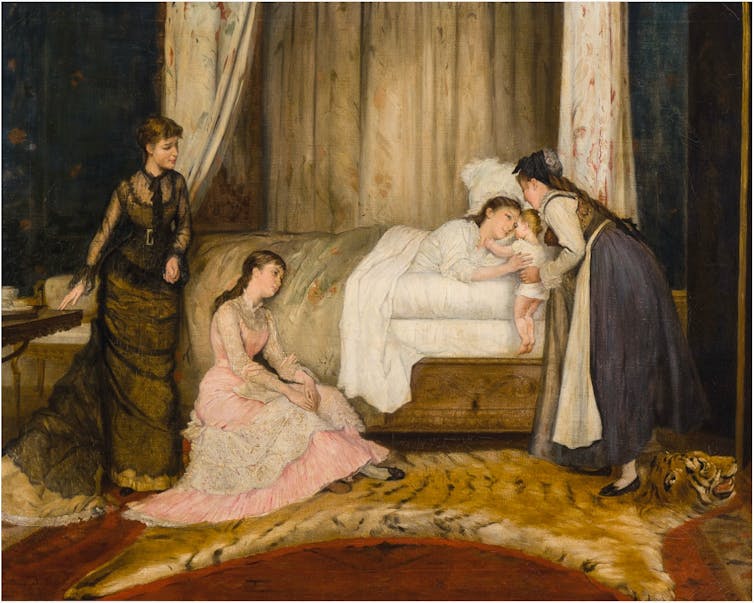
Chloroform was widely welcomed, even garnering an endorsement from Queen Victoria herself, who called it "blessed." But the crude method of administering it – inhaling vapors from a rag – led to dangerously uneven dosing. If as well little was given, the adult female would remain awake and in pain. Yet if as well much was given, they could permanently stop animate. As anesthesia became commonplace, many overdosed and died.
A solution to this problem arrived in the early on 20th century. The same effects of inhaled anesthesia could be achieved with a combination of morphine and scopolamine, intravenous medications that could be advisedly measured in a syringe. This new class of injectable anesthesia was alluringly marketed to significant women equally "twilight sleep." And by the 1930s it became the default approach to childbirth in the United States.
Cruelty in maternity wards
Then, in 1958 the Ladies Home Journal published a disturbing expose chosen "Cruelty in Maternity Wards." In a series of messages, American nurses provided straight accounts of laboring women being left alone for hours, strapped downwardly to beds, crying "violently" and involuntarily writhing against the restraints. At that time, fathers and other family members were not immune in the birthing rooms to show. Under heavy sedation, the memories of the mothers themselves were fuzzy.
The American public was horrified by these descriptions. Pregnant women wanted their voices back. They wanted the chapters to consent. They wanted more than control.
By the 1960s, a newer technology – epidural anesthesia – offered an highly-seasoned alternative. Administered at the level of the spine, epidurals finer bypass the brain, allowing mothers to stay awake and alert during labor, to relay their symptoms and participate in care decisions. But they also crave a unlike merchandise-off. The medicine spreads out to block all nerves that relay and receive signals to and from the pelvis and thighs. These nerves mediate awareness simply besides control all of the key muscles in that region, from the bladder to the quadriceps.
Women with epidurals are unable to urinate on their ain. A catheter must be placed to assistance them. Otherwise, their bladder will simply distend like a balloon. They are as well unable to effectively move their legs and must remain in bed, ordinarily for many hours. Epidurals require more intensive monitoring, a multitude of wires that act as tethers. And by removing pain every bit a bulwark, they bring the potential for more interventions – the same epidurals used for spontaneous vaginal deliveries can be sufficiently dosed for a broad range of procedures, including cesarean sections.
Ceding control (and comfort) on their own terms
Currently, over 70% of birthing women in the U.S. receive epidurals, favoring some measure of comfort over concrete control. However, the popularity of Dar a Luz and other birthing centers suggests that growing numbers appear to exist choosing the reverse trade-off: participation and movement over medical pain relief. Peradventure, all the same, the challenge is not built-in of anesthesia itself but rather a fake pick embedded in the fashion it gets presented, an all-or-zip dichotomy between "natural" and "medical."
At birthing centers, epidurals are not bachelor, and equally a result, labor looks remarkably unlike from the hospital equivalent. While the mother may not necessarily expect comfortable, her movements and her mindset more closely resemble an athlete accomplishing a feat than a patient undergoing an ordeal. Throughout, midwives are in omnipresence to provide support, conscientious monitoring and coaching.
Occasionally, complications develop during labor that brand it necessary for these mothers to be transferred to the hospital. This requires acquiescing to changing circumstances and transferring some control to obstetricians and medical technology.
But the expectation of these mothers is not absolute control whatever more than it is accented comfort. Almost recognize that labor is neither completely controllable nor completely comfy. They, possibly like all people giving birth, simply seek to understand these trade-offs and have the opportunity to cede control – or condolement – on their own terms.
[ Expertise in your inbox. Sign upwards for The Conversation'southward newsletter and get a digest of bookish takes on today'south news, every day. ]
Source: https://theconversation.com/im-an-ob-gyn-who-attended-thousands-of-deliveries-before-wondering-why-americans-give-birth-in-bed-127894
0 Response to "what states is it easiest to give birth in"
Post a Comment