8ball & Mjg 8ball & Mjg - in Our Lifetime Review
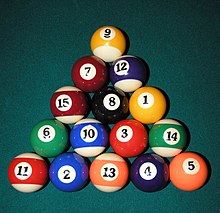 One of numerous proper rack s in standardized eight-ball: The 2 rear corner assurance are of different suits , the 8 brawl is in the center, and the noon brawl is on the foot spot . | |
| Highest governing body | World Pool-Billiard Association |
|---|---|
| Beginning played | 1900s (decade) |
| Characteristics | |
| Contact | No |
| Squad members | unmarried competitors or doubles |
| Mixed-sex | Yes |
| Equipment | Cue sports equipment |
| Glossary | glossary of cue sports terms |
| Presence | |
| State or region | Worldwide |
Eight-ball (as well spelled eight-ball or eightball, and sometimes called solids and stripes, spots and stripes [i] or rarely highs and lows) is a pool billiards played on a billiard table with six pockets, cue sticks, and sixteen billiard assurance: a cue ball and 15 object assurance . The object assurance include seven solid-colored balls numbered 1 through seven, seven striped assurance numbered nine through 15, and the black viii ball. Later on the balls are scattered with a suspension shot , a player is assigned either the grouping of solid or striped balls in one case they accept legally pocketed a ball from that group. The object of the game is to legally pocket the eight-ball in a "called" pocket, which tin can merely be done after all of the assurance from a player's assigned group have been cleared from the table.
The game is the about oftentimes played discipline of pool, and is often thought of as synonymous with "puddle". The game has numerous variations, mostly regional. It is the second most played professional pool game, after nine-ball, and for the terminal several decades ahead of straight pool.[two]
History [edit]
The game of 8-brawl arose around 1900 in the United States every bit a development of pyramid pool, which allows any eight of the fifteen object balls to be pocketed to win. The game arose from two changes made, namely that the 8 ball must exist pocketed last to win, and that each actor may only pocket half of the other object balls. Past 1925, the game was popular plenty for the Brunswick-Balke-Collender Visitor to introduce purpose-made ball sets with 7 cerise , seven yellow , one black brawl , and the cue ball, which allowed spectators to more easily see which conform each ball belonged to. (Such colors became standard in the subsequently British-originating variant, blackball.) The rules, as officially codification in the Billiard Congress of America'south dominion volume, were periodically revised in the years following.[3] : 24, 89–ninety [4] [5] [6]
Standardized rules of play [edit]
American-fashion eight-brawl rules are played effectually the world by professionals, and in many amateur leagues. Still, the rules for eight-ball may be the most inconsistent of any billiard game, every bit there are several competing sets of "official" rules.
The not-profit World Pool-Billiard Association (WPA), which has continental and national affiliates effectually the world (some of which long pre-date the WPA, such equally the Billiard Congress of America) promulgates standardized rules every bit Pool Billiards – The Rules of Play.[vii] These are used for apprentice and professional person play.
Meanwhile, many amateur leagues – such equally the American Poolplayers Association (APA) and its affiliate the Canadian Poolplayers Association (CPA), the Valley National Viii-ball Clan (VNEA) and the BCA Pool League (BCAPL) – use their own rulesets which have slight differences from WPA rules and from each other. Millions of individuals play informally, using informal "house rules" which vary non only from area to expanse but fifty-fifty from venue to venue.
Equipment [edit]
The regulation size of the table'southward playing surface is 9 by 4.5 ft (2.7 past 1.4 m), though exact dimensions may vary slightly by manufacturer. Some leagues and tournaments using the World Standardized Rules may allow smaller sizes, down to vii past three.5 ft (2.1 by i.i m). Early on 20th-century 10 by 5 ft (three.0 by one.v m) models are occasionally also still used. WPA professional person competition mostly employs regulation tables, while the apprentice league championships of various leagues, including BCAPL, VNEA, and APA, use the vii-pes tables in order to fit more of them into the hosting venue.
At that place are seven solid-colored balls numbered 1 through 7, vii striped balls numbered 9 through xv, an 8 brawl , and a cue ball . The balls are usually colored every bit follows:
-
1 solid yellowish nine yellowish stripe two solid bluish ten blue stripe 3 solid red eleven red stripe four solid imperial 12 purple stripe five solid orange 13 orangish stripe half dozen solid dark-green 14 greenish stripe seven solid maroon 15 maroon stripe eight solid blackness ● cue brawl , white
Special sets designed to be more hands discernible on tv substitute pinkish for the dark purple of the 4 and 12 and light tan for the darker maroon of the 7 and 15 balls, and these alternative-color sets are at present also available to consumers.
Setup [edit]
To start the game, the object brawl southward are placed in a triangular rack. The base of the rack is parallel to the end track (the curt end of the pool table) and positioned then the noon ball of the rack is located on the foot spot . The balls in the rack are ideally placed so that they are all in contact with one another; this is accomplished by pressing the balls together toward the apex ball. The order of the assurance should be random, with the exceptions of the viii-brawl, which must exist placed in the middle of the rack (i.eastward., the heart of the tertiary row), and the two back corner balls, i of which must be a stripe and the other a solid. The cue ball is placed anywhere the breaker desires behind the head string .[eight]
Break [edit]
I person is chosen past some predetermined method (e.g., coin toss, lag , or win or loss of previous game or match) to shoot first, using the cue ball to break the object-ball rack apart. In most leagues it is the breaker's opponent who racks the balls, but in some, players pause their own racks. If the breaker fails to make a successful break—usually defined as at least four balls hitting cushions or an object ball beingness pocketed—and then the opponent can opt either to play from the electric current position or to call for a re-rack and either re-interruption or have the original breaker repeat the break.

If the 8 ball is pocketed on the break, and then the breaker can choose either to re-spot the viii ball and play from the electric current position or to re-rack and re-suspension; but if the cue ball is besides pocketed on the pause then the opponent is the one who has the choice: either to re-spot the 8 ball and shoot with ball-in-hand behind the caput string , accepting the current position, or to re-interruption or have the breaker re-break.
Turn-taking [edit]
A role player (or team) continues to shoot until committing a foul or failing to legally pocket an object ball (whether intentionally or non); thereupon it is the plough of the opposing players. Play alternates in this manner for the remainder of the game. Post-obit a foul, the incoming actor has ball-in-hand anywhere on the table, unless the foul occurred on the break shot, as noted previously.[seven]
Option of the target grouping [edit]
The tabular array is "open" at the kickoff of the game, meaning that either player may shoot at whatever brawl. It remains open until one player legally pockets any called ball other than the 8 after the intermission. That player is assigned the group, or suit, of the pocketed ball – 1–7 (solids), or ix–15 (stripes) – and the other suit is assigned to the opponent. Assurance pocketed on the break, or as the result of a foul while the table is still open, are non used to assign the suits.[ix] One time the suits are assigned, they remain fixed throughout the game. If any balls from a actor's suit are on the table, the player must hit one of them first on every shot; otherwise a foul is called and the turn ends. After all balls from the adjust have been pocketed, the player'southward target becomes the eight for the residue of the game.
Pocketing the eight ball [edit]
Once all of a histrion'south (or team's) group of object balls are pocketed, the thespian attempts to sink the 8 ball. In guild to win the game, the player first designates which pocket the viii brawl will be pocketed into and and then successfully pockets the eight ball into that pocket. If the player knocks the eight brawl off the table, the histrion loses the game. If the histrion pockets the eight ball and commits a foul or pockets information technology into another pocket than the i designated, the actor loses the game. Otherwise (i.e., if the 8 brawl is neither pocketed nor knocked off the table), the shooter'due south turn is just over, even if a foul occurs. In brusk, a earth-standardized rules game of 8-ball, like a game of 9-ball, is non over until the " coin ball " is no longer on the table. The rule has been increasingly adopted by amateur leagues.
Winning [edit]
A player wins the game if that player legally pockets the 8 ball into a designated pocket later all of their object balls have been pocketed. Because of this, it is possible for a game to end with only 1 of the players having shot, which is known as "running the table" or a "deprival"; conversely, information technology'southward as well possible to win a game without taking a shot; such a scenario may occur if the opposing histrion illegally pockets the 8 ball on any shot other than the suspension (such as sinking the 8 brawl in an uncalled pocket, knocking the 8 ball off the table, sinking the eight ball when a player is not yet on the blackness brawl, or sinking both the 8 ball and the cue ball off a unmarried shot). The rules on what happens when the eight ball is pocketed off the intermission vary by the rules in question; please read the Fouls section below for more information.
Fouls [edit]
The general rules of pool utilize to eight-brawl, such as the requirements that the cue ball not be pocketed and that a cushion exist hit by any of the balls after the cue ball has struck an object brawl.[10] Fouls specific to viii-brawl are:
- The shooter fails to strike one of their own object assurance (or the 8 ball when it is the legal brawl) with the cue ball, earlier other balls are contacted past the cue ball. This excludes " split " shots, where the cue ball strikes one of the shooter's and one of the opponent's object balls simultaneously.
- If an endeavor is made to pocket a ball, and the brawl hits the pocket, bounces out and lands on the basis, the ball is placed in the pocket and the game continues.
- The shooter shoots the black eight ball without designating the pocket to opposite team members or the lucifer referee in advance.
- The shooter deliberately pockets the opponent's balls while shooting the 8 ball.
- On the break shot, no balls are pocketed and fewer than four balls attain the cushions, in which case the incoming player tin need a re-rack and take the break or force the original breaker to re-pause, or may take ball-in-hand behind the caput cord and shoot the balls as they prevarication.
Variants [edit]
Blackball [edit]
The British version of eight-brawl, known internationally equally blackball, has evolved into a divide game, retaining meaning elements of before pub versions of the game, with boosted influences from English billiards and snooker. It is popular in amateur contest in the UK, Ireland, Australia and some other countries.
The game uses unnumbered, solid-colored object balls, typically red and yellow, with one black viii brawl. They are usually ii inches (51 mm) or 2+ 1⁄16 inches (52 mm) in bore, the latter being the same size as the balls used in snooker and English language billiards. Tables for blackball pool are vi-to-7-foot (ane.viii to 2.1 thou) long, and characteristic pockets with rounded cushion openings, like snooker tables.
The rules of blackball differ from standard viii-brawl in numerous ways, including the handling of fouls, which may requite the opponent two shots, racking (the 8 brawl, not the apex brawl, goes on the spot), choice of which group of assurance will exist shot by which player, handling of frozen balls and snooker s, and many other details.
Internationally, the Globe Pool-Billiard Association and the Earth Eightball Pool Federation both publish rules and promote events. The two rule sets differ in some details regarding the penalties for fouls.
Chinese eight-ball [edit]
The rules are essentially the same as standard WPA rules and the game is played with standard 2+ 1⁄4 -inch (57 mm) solids-and-stripes balls. Withal, the tables are constructed similarly to 9-foot (2.7 k) snooker tables, with rounded pocket openings, napped cloth and flat-faced track cushions. This results in some differences in gameplay approach. The variant arose in the mid-1980s and 1990s as viii-ball gained popularity in China, where snooker was the most popular cue sport at the fourth dimension. With standard American-way pool tables rare, Chinese players made exercise with playing viii-ball on small-scale snooker tables. It has since become the most popular cue sport in China, and the major tournaments take some of the largest prize money in pool.[ citation needed ]
Eight-brawl rotation [edit]
The hybrid game eight-brawl rotation is a combination of eight-ball and rotation, in which the players must pocket their assurance (other than the 8, which remains last) in numerical order. Specifically, the solids player starts by pocketing the 1 ball and ascends to the vii brawl, and the stripes player starts by pocketing the fifteen ball and descends to the 9 brawl.
Backwards eight-ball [edit]
Backwards eight-ball, also called reverse eight-ball, is a variant in which, instead of shooting the cue ball at an object ball to strength the object brawl into a pocket, the player strikes the object ball with their cue so it caroms off the cue ball and into a pocket, in a way similar to Russian pyramid.
Meet also [edit]
- List of World Viii-ball Champions
Notes [edit]
- ^ "Scottish Puddle Association". Archived from the original on xiii April 2014.
- ^ "History of Snooker and Pool". Heaven HISTORY Boob tube channel . Retrieved six Apr 2022.
- ^ Shamos, Mike (1999). The New Illustrated Encyclopedia of Billiards. New York: Lyons Press. ISBNane-55821-797-5.
- ^ Jewett, Bob (Feb 2002). "viii-Ball Rules: The Many Unlike Versions of One of Today'due south Most Mutual Games". Billiards Assimilate: 22–23.
- ^ Hickok, Ralph (2001). "Sports History: Pocket Billiards". Archived from the original on 5 Dec 2006. Retrieved 13 December 2006.
- ^ Shamos, Mike (1995–2005). "A Cursory History of the Noble Game of Billiards". Billiard Congress America. Archived from the original on 27 January 2007. Retrieved xiii Dec 2006.
- ^ a b Pool Billiards – The Rules of Play (PDF). Earth Pool-Billiard Association. 1 January 2008. Archived from the original (PDF) on xix Nov 2011. Retrieved 21 March 2012.
- ^ Billiard Congress of America 2005, p. 46.
- ^ Billiard Congress of America 2005, p. 47.
- ^ Billiard Congress of America 2005, p. 35, 45.
References [edit]
- Dyer, R. A. (May 2005). Billiard Congress of America (ed.). Billiards, Revised and Updated: The Official Rules And Records Book. Rowman & Littlefield. ISBN978-1-59228-744-4 . Retrieved 4 September 2021.
External links [edit]
- World Puddle-Billiard Clan
Source: https://en.wikipedia.org/wiki/Eight-ball
0 Response to "8ball & Mjg 8ball & Mjg - in Our Lifetime Review"
Post a Comment